

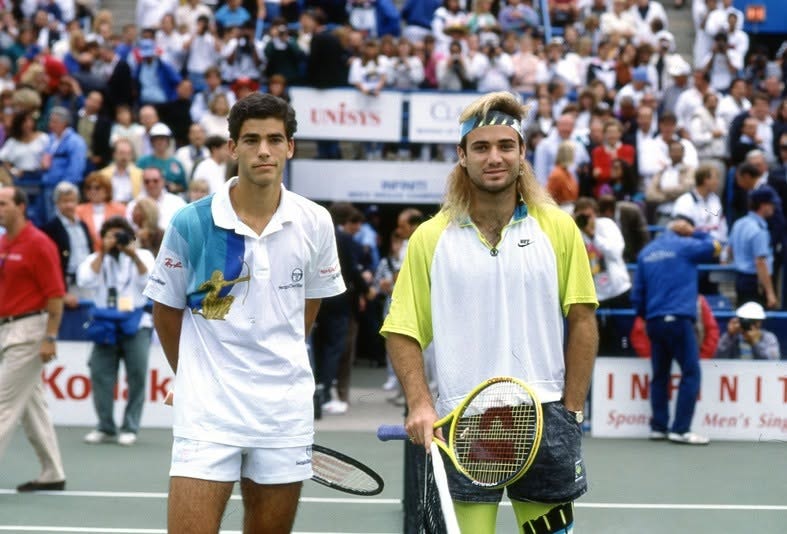
Tennis rivalries are maybe the best. Mano-a-mano; a clash of personalities and styles. They are dramatic and the best ones repeat regularly over a long arc. Borg-McEnroe; McEnroe-Connors; Evert-Navratilova, Federer-Nadal, etc. My all-time favorite was Pete Sampras versus Andre Agassi, perhaps because it was perfectly timed to my own athletic development.
Sampras represented precision and perfection. Tall, fit, graceful, reserved, classy. Agassi was punk rock, a bricklayer with a racquet. Brash. It was country club versus strip mall, and I always rooted for Agassi.
But Agassi’s game and style were the antithesis of how I carried myself. Sampras was quiet and respectful and always poised. I tried to play like Sampras and act like him, too. Agassi’s neon headbands and acid-washed kit were a bad idea then and are a bad idea now. I had no interest in looking like him or acting like him. But there was something about his game. He played every point like he was trying to overcome something. Something deep inside. You could feel it though the TV.
I was a heavy kid. Not really fat, but fat relative to the other boys playing sports. I dreaded shirts and skins, and teammates called me Jelly Belly. In third grade I remember my parents telling me—with some confusion—that I had been selected for the all-star soccer team. I had no idea what an all-star was. Neither did my folks. I turned up to practice feeling like an outsider and the other boys seemed equally confused. But I stuck with it and over time I learned that the super athletic guys weren’t so tough. When things didn’t go their way, they would often give up. I sensed an opportunity and learned I could compete by being consistent—by always showing up.
Consistency became a part of my identity. I prided myself on being predictable and reliable. I never wanted to be another problem the coach had to solve. My best performances I don’t really remember, probably because they were somewhat boring. Things went according to plan. How you practice is how you play. Or as one coach used to say, “Potential is something you lose with.”
In almost every sport I tried, I was good, but not great. The excess weight I carried eventually fell away, but the internal narrative as an outsider persisted. To quote my teenage daughter, I was, “on the outside of the inside.” Close enough to the top dogs to know that I would never be one of them, at least that’s what I told myself. Years later, when I began to compete as a runner, I finished second place in a bunch of races and adopted the self-deprecating moniker of “fastest-loser.”
The irony I’m trying to grasp is that my own version of Agassi’s fury became my motivation to be like Sampras. I was maniacal in my pursuit of consistency. And it pains me to admit that after nearly 52 years with this body, I still struggle to make peace with it.
There was—there is—a rivalry inside of me that might never be settled.